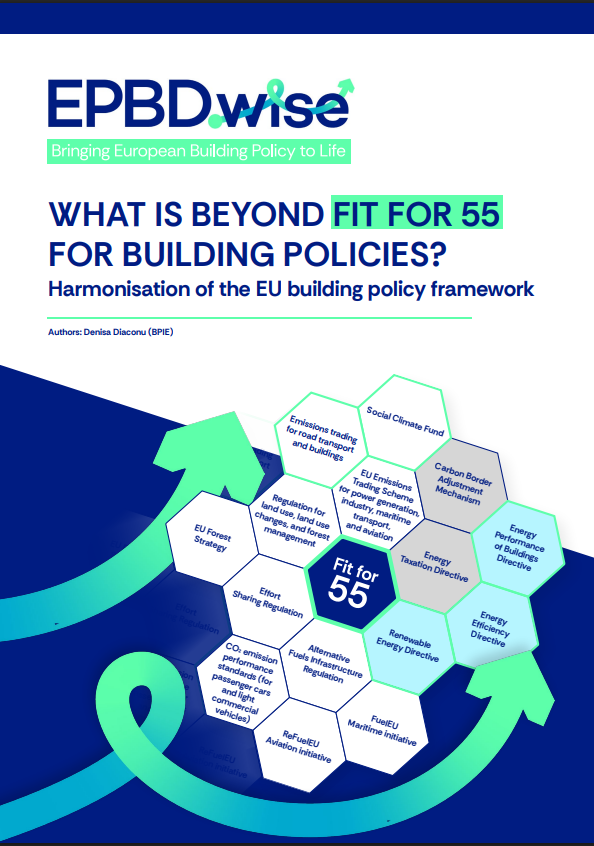
How can the different legislative pillars of the Fit for 55 package work together more effectively to accelerate building decarbonisation?
Five years after its introduction, the Fit for 55 package remains the foundation of the European Union’s climate and energy policy framework. While its legislative instruments were designed to operate as an integrated package, ensuring coherence across the different provisions is essential for achieving the EU’s climate objectives and supporting the transition to a decarbonised building sector.
This latest report from the EPBD.wise project examines the interactions between the key legislative components of the Fit for 55 package and identifies both areas of strong alignment and areas where policy gaps or inconsistencies may limit progress. Particular attention is given to building renovation, energy efficiency, renewable energy deployment, fossil fuel phase-out measures, data systems and social fairness considerations.
The report highlights the importance of aligning building renovation policies with spatial planning processes at national, regional and local levels. It also emphasises the need for high-quality and interoperable data systems, including reliable Energy Performance Certificates, digital building logbooks and integrated databases capable of supporting monitoring, financing and reporting requirements.
A central finding of the analysis is that the Energy Efficiency First principle must remain a guiding element across all relevant policy instruments. At the same time, coordinated fossil fuel phase-out provisions and stronger support for renewable energy deployment in buildings are necessary to ensure a successful transition towards zero-emission buildings.
The report also underlines the importance of maintaining a strong social dimension within the transition process. Vulnerable and energy-poor households must be supported through targeted financial assistance, technical support mechanisms and accessible renovation services to ensure that no one is left behind.
Finally, the report calls for an update of the EU Taxonomy framework to reflect the requirements of the revised Energy Performance of Buildings Directive and to ensure that investment incentives remain aligned with Europe’s long-term climate and energy objectives.
Together, these recommendations provide a roadmap for strengthening policy coherence across the Fit for 55 framework and supporting a more effective and socially balanced pathway towards climate neutrality.
Download the Report