
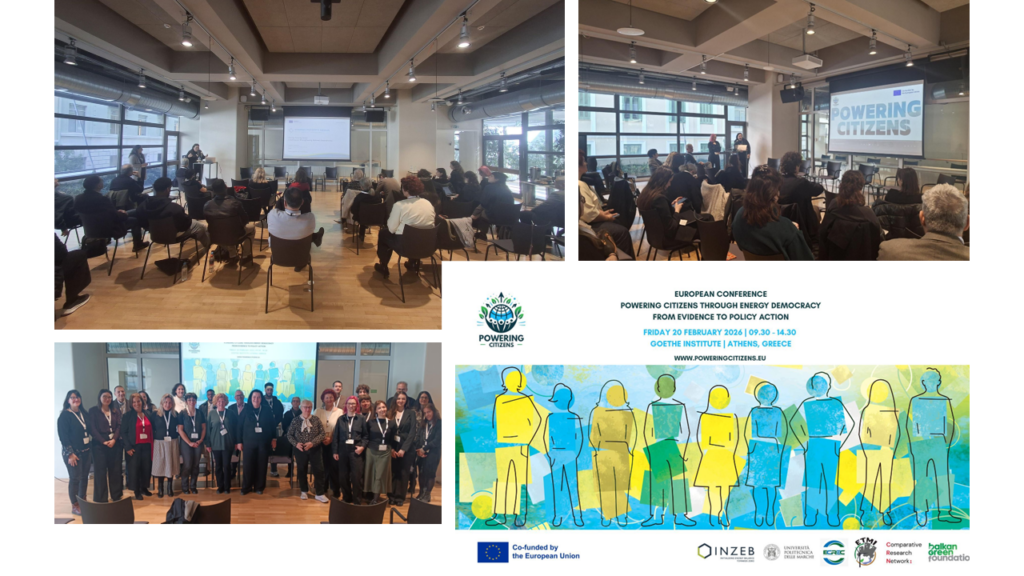
On 20 February 2026, the POWERINGCITIZENS consortium successfully hosted the European Conference “Powering Citizens through Energy Democracy: From Evidence to Policy Action” at the Goethe-Institut in Athens.
Organised by INZEB, with the support of all project partners, the conference brought together experts and policymakers from Greece, Albania, Kosovo, Germany, Italy and the Netherlands to explore how research, digital tools and governance mechanisms can support inclusive, just and effective energy policies, and foster citizen participation in the energy transition.
A central reference point for the discussions was the Policy & Research Report “Powering Citizens: The Social Impact of Energy Communities in Europe”. The report examines how EU climate and sustainability strategies are implemented across six European countries, with a particular focus on energy-poor and vulnerable contexts.
The report’s findings highlight both the potential and the limitations of current governance frameworks in addressing energy poverty, while exposing persistent gaps between policy ambitions and on-the-ground implementation. The report also offers evidence-based recommendations to strengthen energy democracy, promote citizen-led energy initiatives, and integrate energy justice more effectively into climate and social policy.
In this context, country-specific insights presented by the project partners revealed both differences and common patterns across Europe:
• Greece remains among the most structurally exposed EU countries to energy poverty, with persistent regional disparities and a high share of pre-1980 inefficient buildings, prompting the adoption of a new 2026 national methodology targeting a 75% reduction by 2030.
• Germany, despite its strong tradition in energy democracy, continues to face inequalities in participation. Progress in heating, transport and building renovation still falls short of national targets.
• Italy faces structural and persistent energy poverty, affecting between 8% and 16% of households, demonstrating that the issue goes beyond recent energy price crises.
• Kosovo is grappling with the dual challenge of decarbonisation and deep-rooted energy poverty, while working to align with European climate frameworks. However, obstacles from historical coal reliance, institutional inefficiencies, and financial constraints are persistent.
• Albania’s current legislative framework recognises vulnerable consumers based on specific criteria such as disability, health, and income status, but does not fully capture the broader dimensions of energy poverty.
• In the Netherlands, over 6.1% of all households struggles to pay energy costs, with the highest energy poverty rates in North East Groningen, the border areas with Germany, South Limburg and Zeeland.
Across all contexts and countries, one common message emerged: energy poverty is a structural and multidimensional phenomenon, deeply associated with low quality of the existing building stock, income inequality, and governance, institutional and legislative inefficiencies. Speakers emphasised that energy poverty mitigation requires addressing this multifactorial nature, and integrating effectively energy justice into climate and social policy, rather than approaching it as a temporary or isolated issue.
The conference also showcased practical examples of policy instruments and successful mechanisms that can support a more inclusive transition, including:
• One-Stop Shops for renovation and advisory services – The Reverter Project
• Digital platforms for improved energy management – Athens Energy Portal
• Energy communities and citizen-led initiatives – Report: Energy Democracy in Greece: Measuring the social impact of energy communities
• Energy poverty observatories – The Energy Poverty Nexus Project
• Targeted support schemes for vulnerable households –Women in Solidarity for Energy – Wise
The POWERINGCITIZENS European Conference explored critical topics related to energy poverty, reaffirming that energy transition must be fair, inclusive, local and democratic. Country-specific insights and applied, successful examples demonstrate that fostering real dialogue between research, policy and practice can lead to the development of actionable policy recommendations, ensuring that no one is left behind in Europe’s transition toward a more climate-neutral future.